5 cm 7 cm

Illustrated mockup. Product photos coming soon.

Odour absorber

Scent Pouch

A little cotton pouch with a big job. Inside is a pod made from used coffee grounds, activated charcoal and bicarbonate of soda. It's designed to absorb unwanted smells, rather than cover them up with a new one.

£5

Available in person at our trade fairs.

Find a fair
Pouch size
5 × 7 cm
Inside
Coffee-grounds & PCL pod with charcoal and bicarb
Pouch
Printed cotton drawstring bag
Scent
None added: a faint coffee note only up close
Tested
10 out of 10 blind testers smelt less odour
Lifespan
Until the charcoal fills up; sunlight partly refreshes it
What's inside

A pod made from coffee grounds

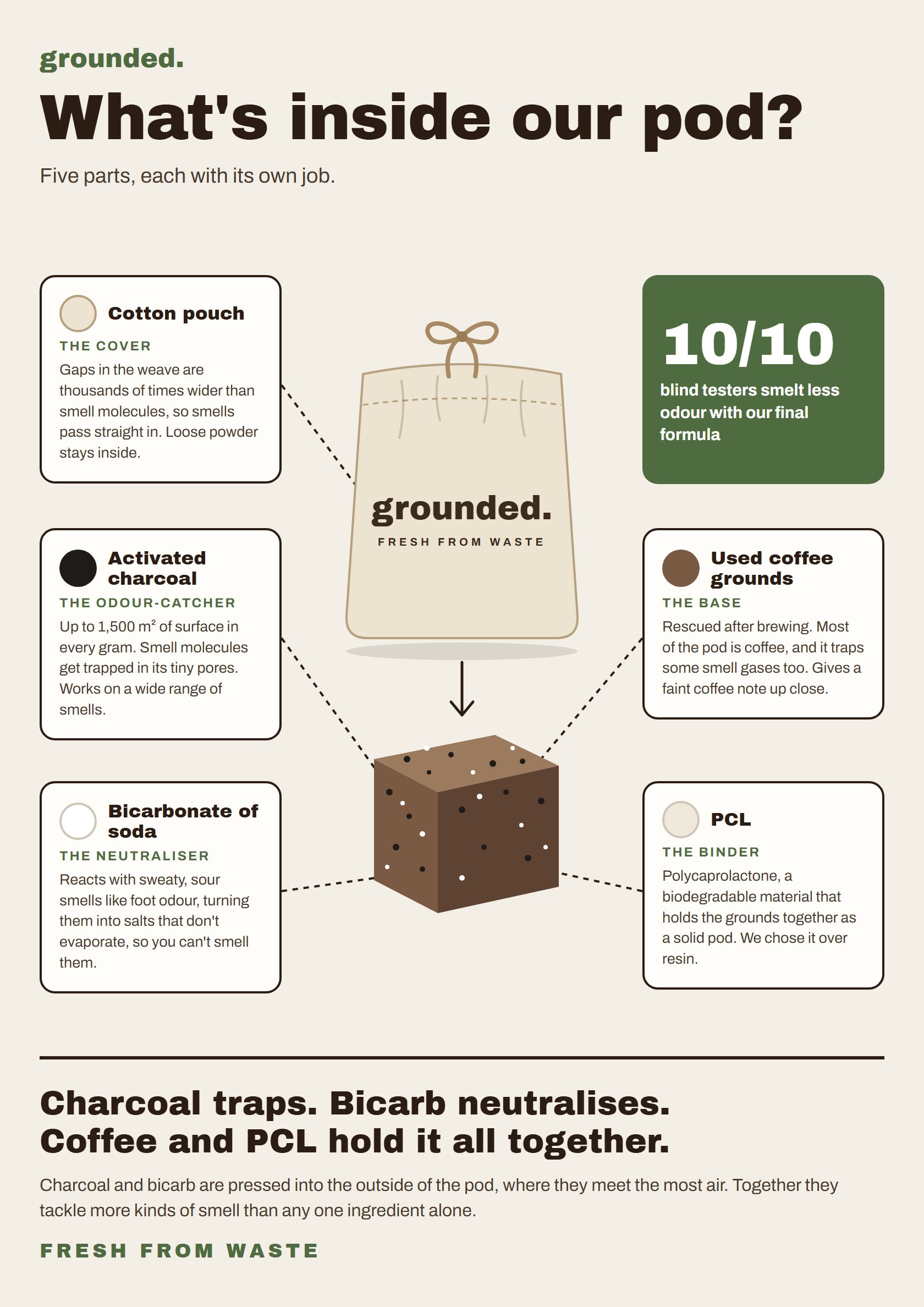
Inside every pouch is a small cuboid pod. We make it by mixing dried, used coffee grounds with PCL and moulding the mix into shape. Then we press activated charcoal and bicarbonate of soda into the outside of the pod, where they have the most contact with the air.

Every pod is speckled and slightly different, because no two batches of coffee are exactly the same. The muslin-style cotton pouch lets smell molecules straight through, because the gaps in the weave are thousands of times wider than the molecules. It also catches any loose powder and carries our logo on the front.

Where to use it

  • Trainers & shoes
  • Gym bags
  • School lockers
  • Drawers
  • Wardrobes
  • The car
The science

Three ingredients, three jobs

Each part of the pod tackles smells in a different way, so together they cover more kinds of smell than any one of them alone.

  • Activated charcoal: the main odour-catcher

    Charcoal full of tiny pores, with 1,000–1,500 m² of surface in every gram. Smell molecules drift in and stick to the walls. Works on a wide range of smells.

  • Bicarbonate of soda: the neutraliser

    Many bad smells are acids, like the isovaleric acid behind foot odour. Bicarb reacts with them to form salts that don't evaporate, so you can't smell them.

  • Used coffee grounds: the base

    The grounds bind with PCL to form the pod and trap some smell gases themselves. They are weaker than charcoal on their own, which is why we added it.

The research behind coffee grounds

Used coffee grounds

Adsorption Characteristics of Volatile Organic Compounds on Used Coffee Grounds Based on the Breakthrough Curves

Hinoue, M. & Hori, H. (2019). Journal of UOEH, 41(4), 417–424.

Researchers passed gas carrying 14 different volatile organic compounds (VOCs), a family of chemicals behind many everyday smells, through ordinary used coffee grounds. They measured how much of each the grounds captured, and found that moisture in the grounds made a difference for some compounds.

Read the study →
Coffee-ground carbon

Spent coffee-based activated carbon: Specific surface features and their importance for H2S separation process

Kante, K., Nieto-Delgado, C., Rangel-Mendez, J. R. & Bandosz, T. J. (2012). Journal of Hazardous Materials, 201–202, 141–147.

A team at the City College of New York turned used coffee grounds into a carbon material that captured hydrogen sulphide, the gas behind the rotten-egg smell of sewers. They linked its performance to nitrogen found naturally in coffee, including in caffeine.

Read the study →
Coffee-ground carbon

Deodorization of Ammonia by Coffee Grounds

Kawasaki, N., Kinoshita, H., Oue, T., Nakamura, T. & Tanada, S. (2006). Journal of Oleo Science, 55(1), 31–35.

Researchers in Japan treated coffee grounds with microwaves and tested them on ammonia, a sharp, pungent smell. Some of the coffee-ground materials held more ammonia than activated carbon, the material used in many air filters.

Read the study →

The honest bit: the first study tested used coffee grounds as they are; the other two processed the grounds into carbon first. Raw grounds like ours are much weaker than carbonised ones, so we don't claim our grounds work like activated carbon. That job goes to the charcoal and bicarb. How well a pouch works in real life depends on the space, the smell and how long it has been in use.

10 out of 10 blind testers smelt less odour with our final formula
Case study

So we tested it ourselves

We sealed each mix in a container with garlic for 7 hours. Ten testers smelt the garlic on its own, then each container in a random order. We then took the garlic out, left the pods in for another 5 hours and tested again.

Share of 10 testers who smelt less odour, by mix
MixGarlic still inGarlic removed
70% PCL, 30% coffee0%0%
60% PCL, 40% coffee0%10%
50% PCL, 50% coffee0%30%
40% PCL, 60% coffee10%70%
Final formula: 40% PCL, 55% coffee, 5% charcoal & bicarb20%100%

The pod works best once the smell source has gone, clearing what lingers in a shoe, bag or drawer. This was a small test run by our team, not a lab study, but it's real evidence from our own product.

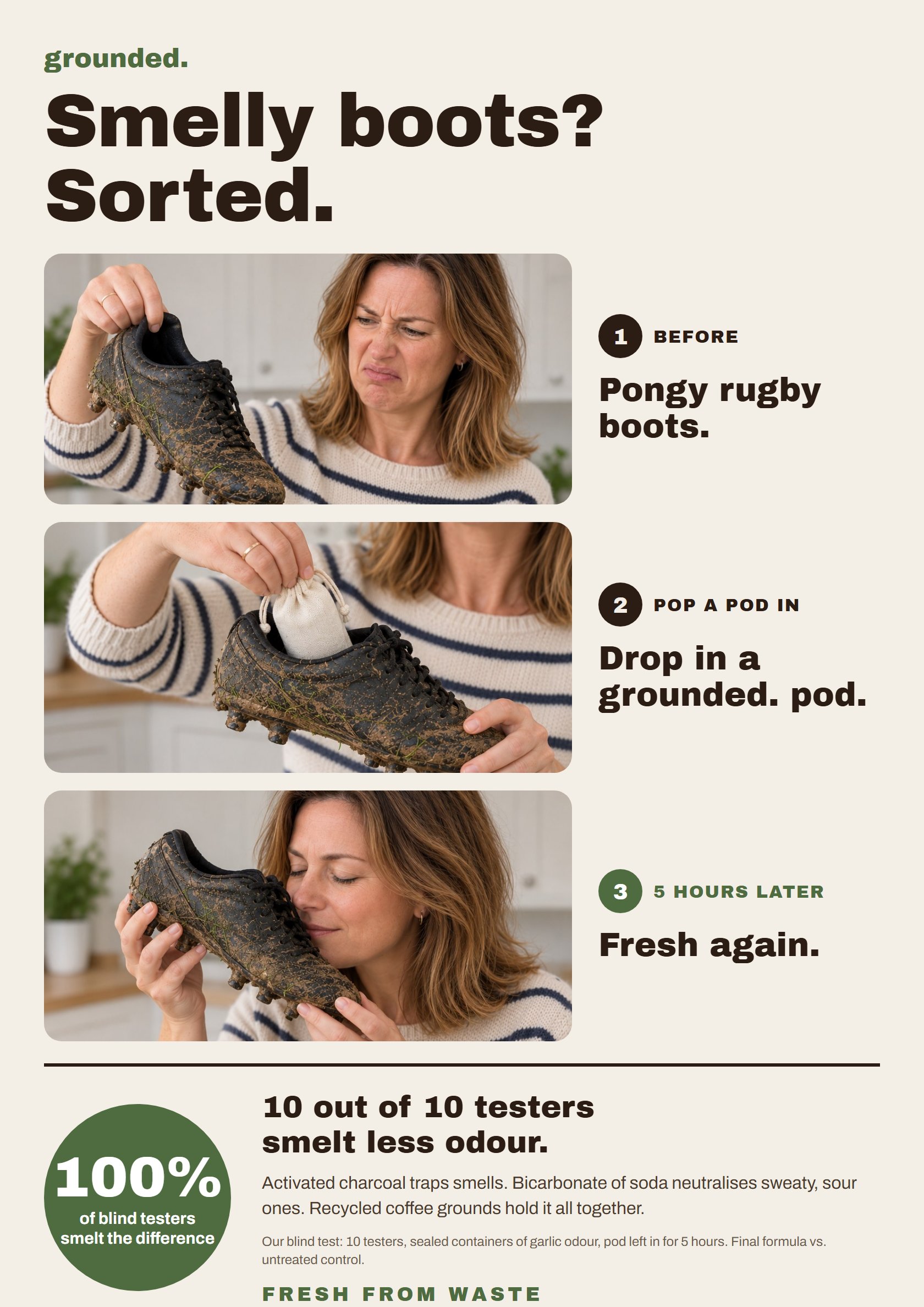
grounded. stall poster titled Smelly boots? Sorted. Three photos show a mum wincing at a muddy rugby boot, dropping a grounded. pod into it, and smelling it happily 5 hours later. A badge reads 100% of blind testers smelt the difference. It explains that activated charcoal traps smells, bicarbonate of soda neutralises sweaty, sour ones, and recycled coffee grounds hold it all together.
On our stall: Smelly boots? Sorted.
grounded. poster titled What's inside our pod? An illustration shows the cotton pouch with a pod below it, labelled with five parts: the cotton pouch is the cover, activated charcoal the odour-catcher, bicarbonate of soda the neutraliser, used coffee grounds the base, and PCL the binder. It also says 10 out of 10 blind testers smelt less odour with the final formula.
On our stall: What's inside our pod?
Using your pouch

Care and safety

Getting wet
Splashes are fine. We put water on a prototype and it didn't go mouldy.
Storage
Anywhere in your home. Somewhere dry works best, as damp air slows the charcoal down.
Refreshing
Leave the pouch in sunlight for a few hours to give it a boost.
Replacing
Over time the charcoal fills up and the bicarb gets used up. When smells come back, it's time for a new pod.
Safety
Do not eat. Keep away from young children and pets.
Size
5 × 7 cm pouch
What it's made of

Kind to the planet, start to finish

Our rule from day one: every part of the product and its packaging should be compostable.

When your pod has done its job, it's designed to be composted rather than thrown in the bin, and the cotton pouch can be reused or composted too.

  • Used coffee grounds

    Rescued after brewing and given a second life. Naturally biodegradable.

  • PCL

    Polycaprolactone, a biodegradable material that binds the grounds into a solid pod. We chose it over resin.

  • Activated charcoal

    A natural carbon that traps smell molecules in its pores.

  • Bicarbonate of soda

    The same baking soda you'd find in a kitchen cupboard.

  • Cotton pouch

    A natural cotton drawstring bag from a UK supplier, printed with our logo.

Our journey

How we landed on the Scent Pouch

We didn't start with a pouch. We started with a bin full of used coffee and a lot of ideas.

  1. Where it started

    Our team met for the first time and set two rules: whatever we make has to turn a profit, and it has to be good for the planet.

  2. Becoming grounded.

    We picked our name, a nod to the coffee grounds at the heart of everything we make.

  3. Lots of ideas

    We explored trainer-cleaning soap, coasters, jar openers, keyrings, fidget stones and tealight holders before narrowing it down.

  4. Smell-free, not coffee-scented

    We decided early on that the pouch shouldn't smell of coffee. Its job is to absorb odours, not cover them with a new one.

  5. PCL over resin, cotton from the UK

    We chose PCL instead of resin to hold the grounds together, and searched UK-only suppliers for a cotton pouch we could print with our logo.

  6. The vote

    The team voted to make the Scent Pouch our main product, with a Christmas decoration alongside it.

  7. Charcoal, bicarb and a blind test

    Coffee grounds alone weren't strong enough, so we added activated charcoal and bicarbonate of soda. Our final formula passed with all 10 blind testers.

  8. Out into the world

    You'll find us at local trade fairs and markets in the run-up to Christmas.

Pick one up for £5

Come and see us at a local trade fair.

See our fairs
Scent Pouch · £5 Find a fair